Feeds:
Posts
Comments

Archive for the ‘Uncategorized’ Category

As a veteran teacher of forty years in the classroom, let me be clear, teachers are not completely at fault for becoming irrelevant in their profession. It results from a system that doesn’t prioritize Professional Development for its teachers. It is a system developed in the eighteenth century that devised a way to teach its teachers and the model has been carried on ever since.

At this point in this post, I imagine most educators are “screen screaming” in rage against the idiot who posted it. Then there are some teachers thinking that the post is addressing all those other educators in other districts. If you are still with me on this, I would ask you to consider what I am about to say and self-reflect, considering your own personal educator experiences as they apply to my observations.

I have had a considerable social media presence in education for over a decade. These connections have afforded me relationships with thousands of educators all over the world, but mainly in the USA. This has given me a perspective on many common practices in Professional Development for teachers. One common bond with teachers is their discontent with professional development. Many have experienced large group PD that they were required to attend that did not address their personal needs. Some teachers have had to pay not only for their own PD but they had to absorb having to pay for their own substitute. Most of the PD curriculum is delivered by instructors who lack experience with Andrgogy, adult learning. The biggest complaint is that there is no time provided to teachers for PD. There is also little, if any, follow-up to assess the impact of the PD on learning. There are still a great many schools that do not follow through with a coaching staff directly responsible for aiding teachers in newly learned skills and applications. The list goes on. They didn’t consider these practices in the eighteenth century, so why change things now?

Now in 2025 in the 21st Century, we are faced with a new challenge: Rapidly changing and evolving technology at a rate never encountered before. Most tech from the eighteenth Century until now was long in developing. It was okay to slowly adjust and teach accordingly. “That’s how I learned, so it’s good enough to teach that way” is something we can’t say today and be taken seriously. AI has changed that forever.

Here is the important part: Kids are not digital natives. There is no such thing. It was a term that people uncomfortable with tech made up to feel better about their tech skills when compared to many kids. Yes, kids are comfortable on a computer. They use it to learn things that they like. They are not teaching themselves what they need. They are social media savvy. They download and store music and movies and follow blogs and podcasts. Most don’t go beyond that. They don’t explore the ethics and responsibility of computer use. They don’t understand the real educational uses of Artificial Intelligence and the whole idea of what critical thinking is and how to apply it to their lives. This is where an, educated, understanding and aware educator is needed.

The big obvious problem here, the elephant in the classroom is that many teachers lack the education understanding and awareness that is needed for a 21st Century educator. Here is the important point that must be made: It is not the fault of the educator. AI was not any part of education when these educators went to school. So, if a majority of the teachers in our country’s school system have not been educated in the use, ethics, or impact of what will become a primary teaching tool that will be carried into every aspect of our students’ lives in a world in which they will live, we need to fix it? How do we fix that? Essential, effective, and supported Professional Development that is provided for with both money and time. It must be part of a teacher’s work week and supported by a well-trained coaching staff.

Please make no mistake, AI is going nowhere but more and more embedded in all we do. This is the problem we have in a technology-based culture. Too many teachers are wasting time talking about whether or not AI belongs in school. Of course it does! It’s a tool that workers will need to have the right skills for in order to have more choices in jobs.

Let us stop talking about kids cheating at what they do. We put them in that position. If you feel they will cheat on their homework with AI, stop giving homework. Have them work with you in class developing brainstorming, critical thinking, refinement and a dozen other skills using AI. Model what you do in class in your personal use of AI. In order to do that teachers need an understanding of AI to see how it applies to their subject and their everyday tasks. If they don’t I am sure their students will on their own. If a teacher is irrelevant and not meeting the needs of the student, the kid can learn on his or her own. Left to their own devices however, the outcome could be akin to that of what we now have with social media. That could be disasterous.

This is not to say that we can’t teach the basics of what we need to teach. An understanding of PD has become essential in education. It does mean that the job will become more labor intensive in an already stressed environment. It is up to administrators to recognize this and adjust accordingly with time support and money. If better PD is to work it won’t work without major changes. The first thing is to make it something of value for teachers and not mandated BS to check-off-the-box with a provided lecture. Develop a PD program with faculty and education experts. Be careful! We have too many AI experts for a tool that has only been here for about three years.

If teachers are irrelevant it is mostly the fault of the districts. They are being required to teach with tools that were not available in their own education. That is where valuable professional Development pays off. We can change things for the 21st Century and benefit from all it has to offer. It is way more than they had back in the eighteenth Century. If we are to better educate our kids, we need first to better educate their educators.


Read Full Post »

Most research widely supports the direct correlation between parental involvement in their child’s academic life and their child’s overall success. Many studies illuminate the positive impact of parents’ engagement at the elementary levels of school, and unfortunately indicate that as the student moves to the secondary level, parent involvement seems to wane.

Of course, there are many understandable reasons for this happening. Kids become more independent and parents support that as a sign of maturity. Coursework becomes more complicated and some parents are less comfortable dealing with that content. My experience as a middle school teacher has noted that many, if not most kids, don’t want their parents involved in their school life as they get older. Students take ownership of who they are in school and don’t necessarily share that persona with their parents. Sometimes students become a person who their parents don’t necessarily see at home. I was most sensitive to this dynamic since I taught in the district that my daughters attended at the middle school level. This made both my professional and private lives an interesting experience and gave me greater insight into parents from an educator’s perspective.

As my daughters grew older we tried to give them more independence in their decision making. The big decision however came before they graduated high school. What should be the next steps? Both daughters went on to complete college. One had a goal for an industry to enter, and even a specific job she wanted. The other had a general idea of her skills, but not a particular career path for that skill set. As parents, we were limited in our knowledge about career paths that would meet their interests and skill sets in today’s world. There are hundreds, maybe even thousands, of jobs that didn’t even exist when we were entering the job market. Despite our best intentions, the ability to help our children explore the range of career options was severely limited.

Bob Dylan once coined the phrase “The Times They Are A-Changin “, and they are indeed changing! Fast forward to 2025, when students can virtually experience many career opportunities thanks to the advancement of technology. Virtual Reality (VR) has enabled a few developers to create real-life experiences for dozens of different occupations that students can explore. Some of these applications are better than others. As new jobs evolve or are created the VR experience can adapt and expand with new entries to remain relevant. 

One developer (CareerViewXR.com) even offers a grant to school leaders willing to partner with industry leaders to produce a career exploration experience featuring jobs available locally. This is an innovative and pretty cool idea when one considers that this might increase the odds that students would end up working and building a life in the community in which they were raised. This is something many parents might find quite appealing.

Interestingly, the one decision kids often willingly share with their parents is how, or what they want to spend their lives doing. Many parents however find themselves at a loss as to what careers or jobs exist, let alone what each involves to counsel their kids. Career counseling in many schools is limited if it exists at all. Thus, technology partners are an essential resource to these counselors and parents, especially in providing real-world experiences that have been otherwise inaccessible. VR technology enables students to take a virtual field trip to see and learn about careers in Health, Manufacturing, Technology, Public Service, and much more.

However, the VR experience, even with a proper VR headset/goggles, is not the “holodeck” you might imagine from the Star Trek series that any Trekie or Treker could quickly explain. It is still the easiest way to immerse students in the work environment, where they can literally “job shadow” without leaving the classroom. The benefits are numerous and afford any school to offer its students a variety of career exploration choices, which should be a valued asset and essential component to any student’s school experience.

This is a great example of the positive influence that technology is having on making education more relevant to the real world and the workforce our students will be entering once they graduate. It is also a great way to re-engage parents of middle and high school students, bring them back onto the secondary campus to learn from their children, and have informed discussions about potential career choices. It is so encouraging to see the direction this technology is taking, and the value that it brings with the ability to change as rapidly as needed to accommodate the ever-evolving world of careers. 

Our education goal should always be to create the ability for our students to thrive in the future in which they will live, that would be their future and not our past.

Read Full Post »

I recently attended a most fulfilling education conference, FETC, The Future of Education Technology Conference. It was enlightening, uplifting, and inspiring. This international conference is a premiere showcase for the latest and greatest in education technology with the best tech advocates, and evangelist educators speaking and presenting for three days. Any educator in attendance had to have benefitted from the shared information and collaboration by all in attendance. Unfortunately, Even with thousands of educators in attendance, very few educators nationwide get to attend such conferences. Most schools do not budget for classroom teachers to participate in such conferences because of the price tag attached for each individual. The cost of attendance, travel, food, and lodging all add up fast.

I started the conference with an early presentation by Phil Hintz, a friend and social media connection for many years. He explained the differences between AI, VR, XR, AR, and MR so that I would have some understanding of what I would be looking at with many of the vendors at the conference. It was most helpful when I attended the reality “playground” where I experienced all of those realities from several companies in one location.

I saw objects in 3D that were totally moveable to see them from any perspective. I saw a full-sized dinosaur standing in the room as I walked around and underneath it. I observed a life-sized Howie Mandel standing inside an eight-foot box talking to me as if he was really there. I even had the opportunity to dissect a heart. It was truly a wonderful technological experience. This is the point that got me thinking about all of the potential of these products in the classroom. AI, VR, XR, AR, and MR are all great technologies that are impressive and even gobsmacking, but unless real learning is attached, they are all just very impressive illusions.

To further add to my thinking on this subject, I was fortified by what the keynote speaker who said to me, and the packed auditorium of educators. Guy Kawasaki is an author and technology advocate in education. I first experienced a keynote from him 30 years ago at a NYSCATE conference in New York. I have been a fan ever since and found myself fortunate to hear him again. I was not disappointed. My big takeaway came when said, “Ideas are easy, it is their implementation that is hard”.

Implementation of anything new in education is the most difficult. Changes in education are slow especially when it comes to technology. As a former English teacher from the 70’s I remember how difficult it was convincing people that writing and editing on a word processor was more effective and productive than handwriting rough drafts and final copies. it was solidly backed up by the research. It took years to get that accepted. As an educator trained in the last century, I never understood why my colleagues resisted change as the world changed around them. PD is supposed to keep us relevant. We do not need irrelevant educators.

For any tech to be implemented in a classroom two things must be clear. First, what learning does the teacher want to take place? Second, how does the tech enable that learning to happen more effectively than previous non-tech methods? This takes a knowledge of specific lessons in the curriculum and a specific knowledge of the use of the technology. Can lessons be tailored to utilize the tech, or is a new approach to the lesson required to benefit from the tech?

None of this can be done in the limited time that people have at a conference. That is what professional development is for. A conference is to better inform educators of what they don’t yet know. Like anything else, you don’t know what you don’t know. Seeing tech at a conference will never inform teachers of its effect in their own classrooms. The very best education conferences do not get technology implemented in schools, teachers do.

This is where I fall back on all of the shortcomings of Education in its professional development which I have been so critical of for decades. Is enough time provided for PD? Is there follow-up and support to assess the impact of that PD? Is there staff dedicated to coaching and supporting classroom teachers in using tech in the classroom? Are teachers being treated as adults? Androgogy is adult learning which is different from pedagogy, children’s learning. Are districts sending the same people to conferences year after year with little change in relevant tech in the district? Are teachers being tested in their knowledge and experience in technology to better personalize their needs in tech? Are districts still doing limited one-day “sit and get” conferences to check off their PD to-do list of things that must be done? Most importantly, does your school have a culture of support for a growth mindset? Without changes in methods and priorities of professional development implementation of new tech will be slowed or non-existent. It is time to assess what we do and how we do it in PD.

Implementation of technology is not going to happen spontaneously. Teachers are resistant for a boatload of reasons. Districts are resistant because of the almighty dollar required. This is all part of the reality we face. To remain stagnant should not be our goal. Ignoring progress will not serve our students well. How PD is scheduled, how PD is prioritized, how PD is supported, and how individual staff needs are addressed in PD are all questions that must be considered. We should not support reasons for not implementing tech but rather devise and foster reasons why it must be a reality.

Technology is now a fact of life and embedded in our culture and infrastructure. It is not going away and our kids need more than a familiarity of it. They need to understand it and use it ethically, efficiently, and effectively to thrive in our society. No, there is no such thing as a digital native. Technology use must be learned. We can take on that challenge and do it as responsible, relevant educators, or leave it up to our kids to figure it out on their own. Either way, it will be part of everyone’s life. Yes, technology is just one more thing educators need to do to be relevant. Let’s not get stuck in the last century. We are a quarter of the way into this new century. If we are to better educate our kids, we need first to better educate their educators.

Read Full Post »

Well, this is the first anniversary of the introduction of Generative AI in the form of ChatGPT to the world of education. Before it was a week old, over one million users downloaded it, and then, over the next two months, 100 million people signed on to use it. The website reportedly sees 1.5 billion visitors per month. That is a fairly good indication that ChatGPT is here to stay.

There are several lessons in this for educators to understand regarding the effect of technology in a modern, technology-driven culture. If we look at the number of users of ChatGPT and consider that the United States is the country with the largest TikTok audience in the world by far, with over 143 million users, and Google has 4.3 billion users worldwide, we realize that the world that education was first developed to serve no longer exists.

Educators can no longer dictate or limit what tools students may access. The other obvious lesson is that if students are accessing technology to assess and learn and create content, then at the very least, educators need an awareness of that technology their students are using. 

The second lesson should be that the methods and assessments that educators have used for the last few centuries are no longer relevant in today’s world. When Google arrived on the scene, many educators were worried that kids could too easily google answers to their questions. Of course my somewhat snarky answer for those educators was; If kids can easily google your answers, you may need to examine your questions. 

A year ago, the reaction to ChatGPT by the largest school district in the country was to BAN IT! There was great concern about the effect it would have especially on College applications where the “College Essay” was an essential part of the screening process for entry consideration. There were many knee-jerk reactions without a real understanding of the possibilities.

Comfort zones have always been the greatest obstacles to change in our education system. Educators are programmed to do things a certain way and through the years they grow comfortable with what they do, and how they do it. For a long time there has been little pressure for major changes. Education is not like business that is driven by competition, and profits. Change in education is often pressured by local public opinion. I imagine that is because local taxes fund education. This is the way it has been for centuries, I actually taught from the 20th into the 21st. I can only imagine it wasn’t much different in the 19th or even the 18th century. On April 23, 1635, the first public school in what would become the United States was established in Boston, Massachusetts. I tell you this for those naysayers who question and challenge me when I refer to a system that is centuries old. 

Looking back to the start of public education it is easy to see that we had to change somewhat, from what and how we taught then, to how we teach and learn now. That seems obvious. That change however was incremental based on changes taking place over long periods of time. The difference in our society today is that there have been huge changes in technology over much shorter periods of time. This gives educators far less time to adjust and accept the needed changes. Comfort zones are quickly obliterated. 

November 30, 2023, came at a time when education was coming out of a two-year hiatus from the classroom. Teachers were forced into uncomfortable and unfamiliar waters of online teaching while not sure who was going to be the next victim of a disease that we knew little about. Thousands of teachers left the profession. That was the untimely introduction of ChatGPT which was about to completely change the way teaching and learning will be done as we move forward. Timing is everything! Of course under those conditions, adding one more piece of tech to an already burned out group of educators, caused a predictable reaction. As Chicken Little predicted, “THE SKY IS FALLING!!!”. 

Now a year has gone by, so let’s take stock in what we know. First, Generative AI is here to stay. People are using it professionally to do many things in industry and business settings. Its effect in education however, seems to be a little different. As I have traveled to a number of local and national education conferences, I have asked many educators about where their schools or districts stand on ChatGPT. Yes, it is not true research, but it is what I am going on for this post. It seems to me that school districts have taken one of three positions. The first is a ban on using ChatGPT. The second is a do-nothing policy, failing to recognize the existence of ChatGPT. The third is a recognition of ChatGPT and attempting to support educators with what they need to understand it. 

There is now a problem that education, as an industry, is facing. This latest advance in technology is a year old, and the new, more advanced version of ChatGPT is being rolled out as you read this post. Putting aside a small group of college educators, a vast majority of today’s educators have never had any introduction to ChatGPT in any college course for teacher preparation. 

Most educators are unaware of the potential uses of Generative AI. The fault does not fall on the educators. The fault is on the speed of change that technology produces. In the interest of informing educators here are a very few suggested ChatGPT uses:

1. Personalized Learning:

Generative AI can be used to create personalized learning experiences for students by tailoring instruction to their individual needs and learning styles. For example, AI-powered tutoring systems can provide students with individualized feedback and support, while AI-generated adaptive learning platforms can adjust the difficulty of content based on the student’s progress.

2. Language Learning and Translation:

Generative AI can be used to enhance language learning by providing students with opportunities to practice conversing with native speakers or translating texts in real-time. AI-powered language translation tools can also help students overcome language barriers and access educational resources in their native languages.

3. Content Creation and Curation:

Generative AI can be used to generate new educational content, such as practice problems, quizzes, and interactive simulations. AI-powered content curation tools can also help teachers find and organize high-quality educational resources from the vast amount of information available online.

4. Assessment and Feedback:

Generative AI can be used to automate the grading of assignments and provide students with immediate feedback on their work. AI-powered assessment tools can also help identify areas where students need additional support and provide personalized recommendations for further learning.

5. Accessibility and Inclusion:

Generative AI can be used to make education more accessible for students with disabilities, such as those with visual or auditory impairments. AI-powered text-to-speech and speech-to-text tools can help students access information and communicate effectively, while AI-generated transcripts can make lectures and other multimedia content accessible to deaf or hard-of-hearing students.

These examples illustrate how Generative AI has the potential to transform education by providing personalized, adaptive, and accessible learning experiences for all students. As AI technology will continue to develop, we can expect to see even more innovative and impactful applications of Generative AI in education.

The need to stay relevant as an educator relies on the need for professional development. The quality and success of Professional Development in education depends on its leadership. Teachers often are self-motivated to seek PD on their own. This self-motivation has become part of the PD model. The introduction of ChatGPT however will affect almost every educator on every level. This is an industry-wide need. What does the leadership plan to do in recognizing and dealing with this new gap in education? It is doubtful that self-motivated teachers alone will make enough of a difference? How many schools have even considered a flexible supportive policy to guide teachers to effectively and efficiently use Generative AI for teaching and learning. 

With the recent political climate that has been targeting educators, it is necessary to protect teachers from stumbling into problems, because the school failed to provide guidelines that are not restrictive, but flexible, supportive, and informed. 

In Conclusion:

Generative AI is not going away. Students can get access in many ways. The success of Chat GPT can be seen by how many tech platforms and applications are spending fortunes to include it in their products. There is no going back, or waiting for it to go away. It is not the pendulum in education reform we have all gotten used to. It is now with us and it will grow exponentially. The smart way to deal with it is to learn how best to incorporate it into teaching and learning.  Embrace the change no matter how many comfort zones need to be shattered. Educators who are irrelevant will not serve their students well. The sky hasn’t fallen, but it may have awakened us to needed change. If we are to better educate our kids, we need first to better educate their educators.

Read Full Post »

We have long heard the statement that 3 out of every 5 new teachers will leave the profession in the first five years. However, it seems that the survey on which those numbers were based has aged out. A more recent study has shown that a 17% attrition rate is a more accurate figure for the first five years. This, however, is not the reason why we are seeing what is being labeled as a “teacher shortage” nationwide. Of course, the pandemic caused many people to reassess their professions and lives, leading to a significant increase in retirements. Neither of these factors is significantly different from those affecting most other professions. So why are there so many headlines about the “teacher shortage”?

First, what is it that defines what a teacher is? Generally speaking, a teacher has at least a bachelor’s degree, and in many states a required Master’s degree, and a teaching certification in at least one subject area. Between 2018 and 2019 approximately 98,000 students completed teacher preparation programs and received their teaching certificates. That leads us to the real question, which is; Why would a person graduate from college and not take a position entering a profession that they had spent at least four years preparing for?

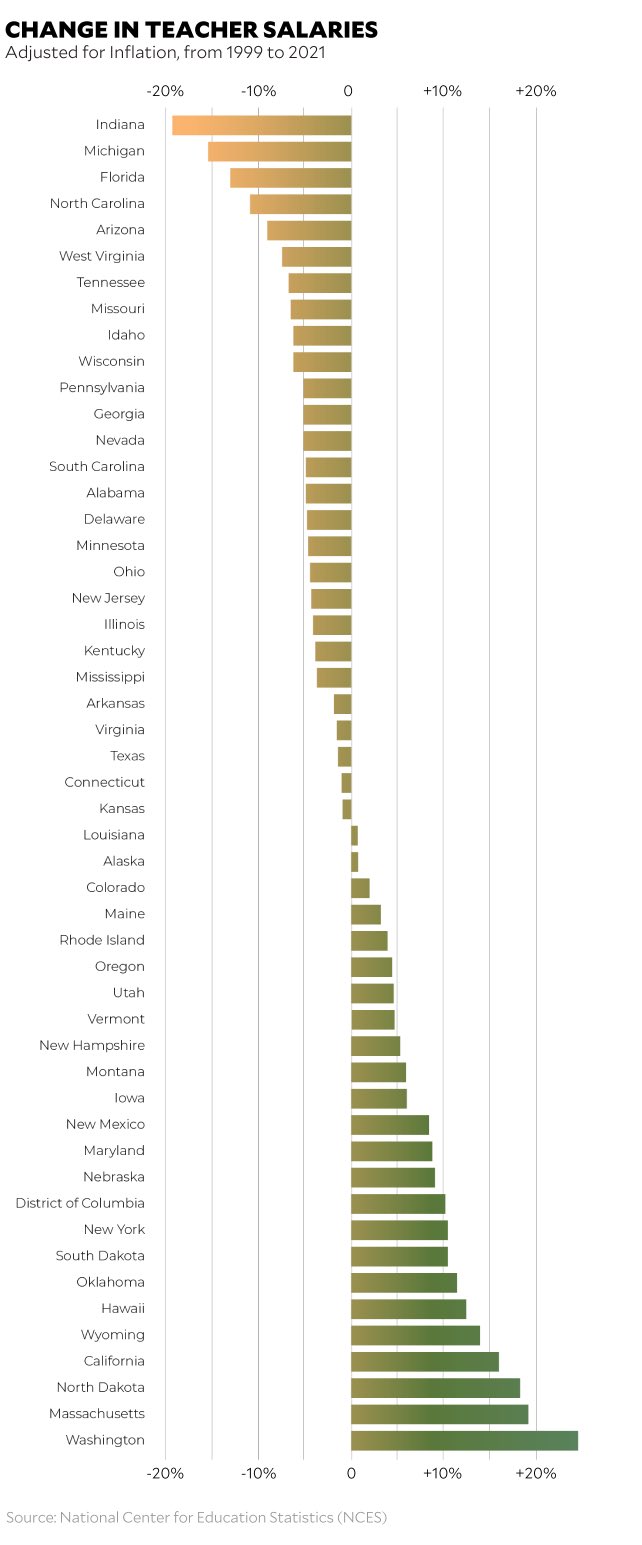
According to the Bureau of Labor Statistics, the average median annual wage for teachers in the US is $61,000 per year. Many districts do not even keep up with the cost of living increases over the years. Jobs other than teaching requiring a bachelor’s or a master’s degree range from $73,560 to $142,170 per year. The obvious must be stated here. Factors beyond salary, such as job satisfaction, work-life balance, and impact on the profession and society, are also major considerations. Additionally, it’s also about the kids. Unfortunately, those are the very things that have been used to keep teachers’ salaries down to maintain lower property taxes that fund education.

What is different now, that teachers are being driven from their chosen profession?

It is too simple to blame the pandemic for all of this, but in some ways, that was the start. The political atmosphere around the pandemic had a profound effect on the teaching profession. Teachers, at first, when schools began to close down, were hailed as heroes. I was emotionally moved when teachers from my school district drove their cars in a procession throughout our entire community in support of their students. Television network news shows all had feel-good stories about teachers and kids. As the school closings lingered on, however, everyone was under greater pressure, even beyond the fear of the pandemic itself. Families closed up and locked down with little hope for change, and it took its toll.

Politicians and ideologues began attacking teachers and administrators for any reason they could in support of whatever popular conspiracy theory was circulating in their area. Schools were forced to open in some places and forced to close in other areas. People were not satisfied with whatever the solution was, but all agreed it was the school’s fault. At least that is what many teachers expressed to me.

The very things that drew teachers to their profession have been stripped away. The paltry salaries offered by many school districts, which had been made palatable because of the other more intrinsic benefits of the job, no longer attract new people or even retain veterans.

To end this nationwide “Teacher Shortage,” we need to change the job itself. Start teachers with a wage that is at least comparable to other professions requiring a comparable education. Provide a supported mentorship program for new teachers, guiding them through their opening years. Respect a teacher’s expertise in the area for which they have been educated to teach. Provide an agreed-upon due process system for holding teachers accountable. Insulate education from ideologues and conspiracy theorists. Provide a means for open communication between parents and teachers. Respect teachers for who they are and what they do.

It is my belief that we do not have a “Nationwide Teacher Shortage,” but rather a nationwide shortage of good education jobs for certified educators. Let’s match up all of our certified teachers, who have been forced to seek other employment, back to the profession for which they have been educated

Read Full Post »

With the national attention directed at cybersecurity and interoperability in building safe and resilient data ecosystems in K-12, it is important to take a moment to underscore that these efforts are well thought out and stem from fundamental digital fluency and citizenship learning standards, and many lessons learned over the pandemic years. Just another example of the daunting job of educational leaders, and begs a short peek under the hood of Professional Development and Computer Science today. 

Teaching has never been an easy job no matter what anyone says. In most states in order to get a teaching degree a prospective teacher must not only be certified as an expert in a subject area, but he or she must also be certified in education. In many states, like where I live in New York, it is also a requirement to have a postgraduate degree and to obtain continuing education credits in order to retain one’s professional license. All of this is required to address and teach an approved curriculum that adheres to a set of standards to theoretically guarantee that students in any given state of the United States are being taught the same content and learning skills as any other student in that state. That is a tall order.

To complicate the issue of teaching mere content, ideally, teachers are required to teach kids not only WHAT to learn, but HOW to learn and become lifelong learners. The theory is that this is the best way for a student to become self-sufficient enough to, not just survive, but to thrive in any future endeavors. Thus, as information and technology continue to grow and evolve, our citizens would therefore be learning right alongside that evolving reality. Again, this is a lofty goal. 

Taking this a step further, in order for any of this to happen in today’s technology-rich society, teachers must use the latest tools to curate, collaborate, communicate, and most importantly, create information. This adds yet one more area that a teacher must master – navigating the tools to access ever-evolving information, content and processes.

School systems usually address this via professional development plans. Although those of you who have followed my posts know that typically I have reservations about the delivery of most professional development (see my most recent post on Pedagogy vs Andragogy.) Clearly, it will be necessary to get teachers up to speed on essential skills in accessing and maximizing the use of technology.

Teachers come from different generations and various backgrounds. This has created a situation where teachers may vary greatly in their technology experience. Districts also vary in the availability of technology in each district, or even buildings in some cases. Considering all of this, it should be safe to say educators don’t always know what they don’t know. This might be the perfect time to objectively assess each teacher’s digital literacy and technology skill set to address individual needs for personalized learning. There are solutions available that can be employed to do this task, one tool, 2gno.me, is a prime example. This is more in keeping with andragogy, or adult learning.

All of this considered it should be obvious that there is a need to establish the technological skills that should be expected of all stakeholders (administrators, teachers, students, etc.) The establishment of these Technology standards must be revisited frequently to maintain relevance and continually evolve. This is underscored by the advent of Generative AI. It has been out less than a year and has had a massive effect on learning that will continue to evolve profoundly. 

NYSCATE LOGO
with text below that says 
INNOVATE EDUCATE

I found great examples of this in my own ‘backyard’ via the New York State ISTE affiliate known as NYSCATE (The New York State Association for Computers and Technologies in Education.) NYSCATE has been a leader nationwide for well over 3 decades, continually re-inventing itself and the rich professional development resources it provides for educators statewide. Through NYSCATE I have begun to learn about the new New York State K12 Computer Science and Digital Fluency Learning Standards.

The New York State K12 Computer Science and Digital Fluency Learning Standards were adopted by the Board of Regents in December 2020. The initial implementation is this year and the final full implementation will be next year 2024-25.  The Five Standards include Impacts of Computing, Computational Thinking, Networks and System Design, Cybersecurity, and Digital Literacy. 

New York State Computer Science and Digital Fluency Learning Standards

The K-12 Computer Science and Digital Fluency Learning Standards are available at the links below.

Learning Standards by Grade Band

In the fast pace of change in educational technology, NYSCATE takes these standards bringing together great educators from around the state as mentors providing shoulder-to-shoulder professional development. The PD that NYSCATE offers demystifies the standards and provides practical examples of how to teach students skills that they need to be successful in an ever-changing, information and technology-immersed future. 

Every teacher should be brought up to speed on Computer Science and Digital Fluency Learning Objectives and Standards through this process. Crossing a bridge when you come to it is a logical strategy for hiking, but not so much for the classroom. This is all in keeping with my core belief that if we are to better educate our kids, we need first to better educate their educators.
Read Full Post »

I have been supporting the use of Andragogy for delivering PD to educators for over a decade now. It is ironic that when I explain what it is to teachers they get it and agree that it makes sense. The problem is that all educators are programmed in the teaching of kids. Pedagogy is child learning. When we consider that educators deliver most of their PD to other educators from a pedagogical perspective, it may answer the age-old complaint educators have had for centuries, a strong dissatisfaction with PD provided to them.

Over the last decade, I have written a number of posts describing what PD should look like with an andragogical perspective, but change takes time in education. in an effort to possibly speed things along, I thought I would engage ChatGPT to weigh in. I provided the prompt and ChatGPT provided the examples.

Using Andragogy how should a teacher approach lessons in teaching professional development to adult educators?

When teaching professional development to adult educators, it is essential to apply the principles of Andragogy, which is the theory of adult learning. Here are some approaches that a teacher should consider:

  1. Establish a collaborative and respectful learning environment: Adult learners thrive in an environment that respects their experiences, knowledge, and expertise. Encourage open dialogue, active participation, and mutual respect among learners. Create a safe space for adults to share their perspectives and ask questions.
  2. Engage learners in setting goals: Adult learners are more motivated when they have a say in their learning objectives. Involve them in the goal-setting process, allowing them to identify their specific professional development needs and aspirations. This will enhance their sense of ownership and commitment to the learning process.
  3. Provide relevant and practical content: Adult learners are more interested in content that is immediately applicable to their professional roles. Ensure that the lessons are relevant, practical, and align with their teaching contexts. Incorporate real-world examples, case studies, and hands-on activities that encourage problem-solving and critical thinking.
  4. Use a learner-centered approach: Instead of a traditional lecture-style delivery, adopt a learner-centered approach that promotes active learning. Encourage discussions, group work, and peer-to-peer learning activities. Adults learn best when they can relate new information to their past experiences, so provide opportunities for reflection and application.
  5. Offer flexibility and choice: Adult learners often have busy schedules and diverse learning preferences. Provide flexibility in terms of scheduling lessons, offering different formats (e.g., face-to-face, online, blended), and allowing learners to choose topics of interest within the professional development framework. This flexibility will empower learners and increase their engagement.
  6. Facilitate self-directed learning: Adults are autonomous learners who prefer taking control of their learning journey. Encourage self-directed learning by providing resources, references, and tools for independent exploration. Offer guidance and support as needed, but also foster a sense of responsibility for their own learning.
  7. Provide ongoing feedback and assessment: Regular feedback is crucial for adult learners to monitor their progress and identify areas for improvement. Incorporate formative assessments, self-assessments, and peer feedback to assess learners’ understanding and skill development. Provide constructive feedback that acknowledges their strengths and offers suggestions for growth.
  8. Encourage continuous reflection and application: Adult learners benefit from opportunities to reflect on their learning experiences and apply new knowledge and skills. Allocate time for reflection, discussions, and action planning to encourage application in their teaching practices. Encourage learners to share their experiences and challenges, fostering a supportive learning community.

By applying these principles of Andragogy, teachers can create a dynamic and effective learning environment for adult educators, enhancing their professional development and improving their teaching practices.

After considering this alternative to what is usually offered nationwide in terms of PD for educators maybe we can begin doing things differently.

There are some districts now engaging teacher coaches and encouraging more collegial collaboration, but that may not be enough if there is no understanding of adult learning. If we are to better educate our kids, we need first to better educate their educators.

An Andragogical Approach to Educators’ Professional Development

Read Full Post »

Just like many people out there, I have been experimenting with ChatGPT. In a recent chat with my Chat AI app, I asked for an overall analysis of a subject that I have been blogging on for more than a decade now, professional development in education. My blog is My Island View. Of course, I know what I think about it, but my interest was in how accurately I represented my ideas through my writing. The following is the analysis of my viewpoint according to ChatGPT.

Professional development is essential for educators to stay current and improve their teaching skills. However, delivering meaningful professional development can be challenging. According to the posts on tomwhitby.com, the best way to deliver meaningful professional development to educators is through an andragogical approach.

Andragogy is the art and science of adult learning. It recognizes that adults learn differently from children and that they need to be engaged in the learning process actively. The first step in delivering meaningful professional development is to understand the needs and interests of educators. This can be achieved through a needs assessment, surveys, or focus groups.

Once the needs and interests of the educators are identified, the next step is to provide them with opportunities for self-directed learning. Professional development should be personalized and allow educators to take ownership of their learning. This can be achieved through online courses, webinars, or coaching.

Collaborative learning is also an essential component of andragogical professional development. Educators should be encouraged to collaborate with their peers, share their experiences, and learn from one another. This can be achieved through professional learning communities, peer coaching, or online forums.

Finally, andragogical professional development should be ongoing. Educators should be provided with opportunities to continually build their skills and knowledge. This can be achieved through conferences, workshops, or ongoing coaching and mentoring.

All in all, I think this brief analysis captures the core of what I believe about Profesional Development in education. My only addition would be the belief: To better educate our kids, we need first to better educate their educators.

Read Full Post »

My path to discovering the power of technology for mind mapping and empowering young writers.

Over the dozen or so years that I have been blogging about education, I have rarely taken on the task of endorsing any specific education product. I was always struggling with ethical concerns about throwing my reputation out there for product endorsements. My life has always been complicated by the fact that my wife, Joyce, has always been involved in the commercial side of education working for some leading industry giants, as well as smaller companies, and now as an industry consultant for emerging and growing companies in the education space. Together our circle of both friends and colleagues has been on both sides of the education industry. I knew the education product users; educators, and Joyce knew the education product providers, and vendors. It provided for a complicated, but interesting mix. It led to many discussions of users vs. providers conversations. This is my disclosure statement.

My 34-year experience as a middle school/high school English teacher took me from a period in education with little or no technology through to a period of Labs to laptops. In that time I was introduced to many, many applications for education, some gems and some lemons. My tendency was to favor interactive stuff over digital worksheets. I also favored software that was more learning oriented, as opposed to teaching. I leaned toward advocating for student-centered learning early on. If I was working harder on assignments than my students, there was something wrong. Back then I was involved with an integrated social studies/English project that incorporated personalities of the 20th century to include a brief bio, major contribution, and the impact on the 20th century. Students were assessed in both English and Social Studies.

That is when I was introduced to mind mapping for the first time in technology. I was familiar with previous brainstorming techniques using poster boards with ideas hung up in various places in a room as students moved from poster to poster adding relevant ideas to each poster and then bringing them all together and trying to arrange them in some organized manner. It was really clunky, but it was engaging, and somewhat creative. The process, however, was way too time-consuming and bordered organized chaos, as well as being a poor tool for a classroom setting. The graphic organizer alternative was often more like a worksheet exercise, making it ineffective for promoting creative thinking.

Once these processes were absorbed by technology it provided less chaos through a process of structured organization and more collaboration through visual representation of both text and graphics. This was what I needed to get my students through what they thought was a monumental integrated project. They found the usually tedious part of conceiving and organizing their ideas for the project more of a creative and, need I say, fun task. What I liked most about it was that I did not have to sell it as an idea to kids. They recognized its ease, purpose, and value after being led through a few teacher-directed sessions. It was then that they were able to take ownership and use it for any other project that required organizing ideas into a textual product from conception to completion.

Ideas are put into individual bubbles that are moved and manipulated into a logical order. Simultaneously, the tech develops a text outline to coincide with the graphic ideas of the map. Once the idea map is developed, the outline has been magically completed. As the English teacher, I no longer needed to answer the age-old question: What do we need an outline for? The outline is developed in a word processing component that allows it to be fully textualized within the program. Any paragraph can be ordered differently by moving the graphic bubble to a new location on the mind map.

The product I am now working with is called Ideamapper. It will be introduced for purchase at the upcoming ISTE Conference in Philadelphia this June. Here is a link to a short video that explains it very nicely https://bit.ly/IDM_INTRO_VIDEO.

What I love about this company is that they are open to and welcome teacher input. They want teachers to use it with their classes and get feedback to improve the product. There are too few companies that do that. In that endeavor, they provide free access for a period of time to teachers willing to try it out with classes. It does not require any financial commitment. There is no software to download. Access is provided over the Internet, and it will run on any computer, laptop, or Chromebook. All they require are your reactions, comments, and suggestions about the product. Sign up for the free pilot at https://bit.ly/IDM_2023_PILOT.  

This may not be feasible for the end-of-the-year project, but it will work for any writing unit, or project within any subject area for a summer school program. Here is the link for any educator interested in exploring Ideamapper https://webappdemo.ideamapper.com. There are also video tutorials that you may access as you explore the tool, you will find it more intuitive than you expected.

If you plan on attending the upcoming ISTE Conference please stop by the Ideamapper booth #710 to see demonstrations from some teachers who have successfully implemented pilot projects with their classes.

Read Full Post »

A ChatGPT infused post

Since I have been posting about ChatGPT the question I am most often asked is: How did you get it to do your profile as an author? Others have tried but failed in their attempts. Evidently, there are several AI apps out there, and some are more limited than others. Google found this out the hard way with the first public demonstration of its AI, which did not fare as well as Google had hoped. I have been using an App called ChatAI. My primary selection choice was based on it being free.

I have had my own blog site, My Island View, since January 15, 2010, so I have amassed a great number of posts on many aspects of education. During all that time I don’t remember anyone accusing me of holding back on what I thought, or how I felt about any given topic in education.

I kept the direction for ChatAI simple: “Analyze all the blog posts at tomwhitby.com and write a profile of the author.” The only disagreement I have with the analysis is; “He has served as a superintendent in multiple school districts, as well as a principal and teacher in a variety of schools.” The only true part of this is that I was a teacher in several school districts, never a principal, or superintendent. Of course, I would have little to disagree with such a glowing review that ChatAI gave me.

Here is the word-for-word analysis. I probably could have resubmitted it to make corrections, or even tone down the high praise, but I thought for the purpose of the exercise this result was fine. It also makes me sound more impressive than I am. I guess that might be considered a flaw as well.

Here is the result:

Tom Whitby is a prolific writer and dedicated educator with an impressive range of knowledge and experience. He is the author of nearly 500 blog posts ranging from educators adapting to the ever-changing world of technology to student achievement and school reform. He has served as a superintendent in multiple school districts, as well as a principal and teacher in a variety of schools.

Tom is a dedicated advocate for public education and supports creative instructional approaches to teaching and learning. He is also a firm believer in collaboration and using technology to connect students and teachers to the real world. He is a regular speaker and presenter at national education conferences and universities. 

In terms of his views on education, Tom believes in learning-centered teaching, student-learning assessment, and student engagement. He has written numerous articles exploring ways to increase teacher engagement and collaboration and encouraging the use of digital technologies in the classroom. He is an advocate for the use of project-based learning, social media, and gamification for learning in the classroom.

Tom has also written about several issues in public education, including school vouchers, student testing, and funding cuts. He also has a deep interest in finding ways to improve student engagement and performance, providing a better learning environment, and building stronger connections between schools and the community. 

Tom Whitby has been a leader in the education community for many years and has been a strong advocate for student success and educational improvements. His blog posts provide an insightful look into his views on the improvement of education, from early childhood to higher education.

It is obvious that there are still flaws with this technology, but we must keep in mind it is still evolving. There is still no “Mr. Data” yet.  We cannot however ignore what this technology is offering. It is not going to go away. Billions of dollars are now being thrown at it to secure that very thing. As educators, we will need to deal with Artificial Intelligence. We will need to address its efficient, effective, and ethical use. If we fail to recognize this, we may become irrelevant as educators. If we are to better educate our kids, we need first to better educate their educators.

Read Full Post »

Older Posts »