
Well, this is the first anniversary of the introduction of Generative AI in the form of ChatGPT to the world of education. Before it was a week old, over one million users downloaded it, and then, over the next two months, 100 million people signed on to use it. The website reportedly sees 1.5 billion visitors per month. That is a fairly good indication that ChatGPT is here to stay.
There are several lessons in this for educators to understand regarding the effect of technology in a modern, technology-driven culture. If we look at the number of users of ChatGPT and consider that the United States is the country with the largest TikTok audience in the world by far, with over 143 million users, and Google has 4.3 billion users worldwide, we realize that the world that education was first developed to serve no longer exists.
Educators can no longer dictate or limit what tools students may access. The other obvious lesson is that if students are accessing technology to assess and learn and create content, then at the very least, educators need an awareness of that technology their students are using.
The second lesson should be that the methods and assessments that educators have used for the last few centuries are no longer relevant in today’s world. When Google arrived on the scene, many educators were worried that kids could too easily google answers to their questions. Of course my somewhat snarky answer for those educators was; If kids can easily google your answers, you may need to examine your questions.
A year ago, the reaction to ChatGPT by the largest school district in the country was to BAN IT! There was great concern about the effect it would have especially on College applications where the “College Essay” was an essential part of the screening process for entry consideration. There were many knee-jerk reactions without a real understanding of the possibilities.
Comfort zones have always been the greatest obstacles to change in our education system. Educators are programmed to do things a certain way and through the years they grow comfortable with what they do, and how they do it. For a long time there has been little pressure for major changes. Education is not like business that is driven by competition, and profits. Change in education is often pressured by local public opinion. I imagine that is because local taxes fund education. This is the way it has been for centuries, I actually taught from the 20th into the 21st. I can only imagine it wasn’t much different in the 19th or even the 18th century. On April 23, 1635, the first public school in what would become the United States was established in Boston, Massachusetts. I tell you this for those naysayers who question and challenge me when I refer to a system that is centuries old.
Looking back to the start of public education it is easy to see that we had to change somewhat, from what and how we taught then, to how we teach and learn now. That seems obvious. That change however was incremental based on changes taking place over long periods of time. The difference in our society today is that there have been huge changes in technology over much shorter periods of time. This gives educators far less time to adjust and accept the needed changes. Comfort zones are quickly obliterated.
November 30, 2023, came at a time when education was coming out of a two-year hiatus from the classroom. Teachers were forced into uncomfortable and unfamiliar waters of online teaching while not sure who was going to be the next victim of a disease that we knew little about. Thousands of teachers left the profession. That was the untimely introduction of ChatGPT which was about to completely change the way teaching and learning will be done as we move forward. Timing is everything! Of course under those conditions, adding one more piece of tech to an already burned out group of educators, caused a predictable reaction. As Chicken Little predicted, “THE SKY IS FALLING!!!”.
Now a year has gone by, so let’s take stock in what we know. First, Generative AI is here to stay. People are using it professionally to do many things in industry and business settings. Its effect in education however, seems to be a little different. As I have traveled to a number of local and national education conferences, I have asked many educators about where their schools or districts stand on ChatGPT. Yes, it is not true research, but it is what I am going on for this post. It seems to me that school districts have taken one of three positions. The first is a ban on using ChatGPT. The second is a do-nothing policy, failing to recognize the existence of ChatGPT. The third is a recognition of ChatGPT and attempting to support educators with what they need to understand it.
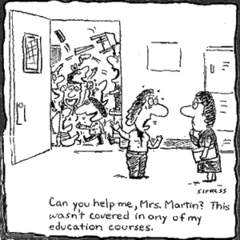
There is now a problem that education, as an industry, is facing. This latest advance in technology is a year old, and the new, more advanced version of ChatGPT is being rolled out as you read this post. Putting aside a small group of college educators, a vast majority of today’s educators have never had any introduction to ChatGPT in any college course for teacher preparation.
Most educators are unaware of the potential uses of Generative AI. The fault does not fall on the educators. The fault is on the speed of change that technology produces. In the interest of informing educators here are a very few suggested ChatGPT uses:
1. Personalized Learning:
Generative AI can be used to create personalized learning experiences for students by tailoring instruction to their individual needs and learning styles. For example, AI-powered tutoring systems can provide students with individualized feedback and support, while AI-generated adaptive learning platforms can adjust the difficulty of content based on the student’s progress.
2. Language Learning and Translation:
Generative AI can be used to enhance language learning by providing students with opportunities to practice conversing with native speakers or translating texts in real-time. AI-powered language translation tools can also help students overcome language barriers and access educational resources in their native languages.
3. Content Creation and Curation:
Generative AI can be used to generate new educational content, such as practice problems, quizzes, and interactive simulations. AI-powered content curation tools can also help teachers find and organize high-quality educational resources from the vast amount of information available online.
4. Assessment and Feedback:
Generative AI can be used to automate the grading of assignments and provide students with immediate feedback on their work. AI-powered assessment tools can also help identify areas where students need additional support and provide personalized recommendations for further learning.
5. Accessibility and Inclusion:
Generative AI can be used to make education more accessible for students with disabilities, such as those with visual or auditory impairments. AI-powered text-to-speech and speech-to-text tools can help students access information and communicate effectively, while AI-generated transcripts can make lectures and other multimedia content accessible to deaf or hard-of-hearing students.
These examples illustrate how Generative AI has the potential to transform education by providing personalized, adaptive, and accessible learning experiences for all students. As AI technology will continue to develop, we can expect to see even more innovative and impactful applications of Generative AI in education.
The need to stay relevant as an educator relies on the need for professional development. The quality and success of Professional Development in education depends on its leadership. Teachers often are self-motivated to seek PD on their own. This self-motivation has become part of the PD model. The introduction of ChatGPT however will affect almost every educator on every level. This is an industry-wide need. What does the leadership plan to do in recognizing and dealing with this new gap in education? It is doubtful that self-motivated teachers alone will make enough of a difference? How many schools have even considered a flexible supportive policy to guide teachers to effectively and efficiently use Generative AI for teaching and learning.
With the recent political climate that has been targeting educators, it is necessary to protect teachers from stumbling into problems, because the school failed to provide guidelines that are not restrictive, but flexible, supportive, and informed.
In Conclusion:
Generative AI is not going away. Students can get access in many ways. The success of Chat GPT can be seen by how many tech platforms and applications are spending fortunes to include it in their products. There is no going back, or waiting for it to go away. It is not the pendulum in education reform we have all gotten used to. It is now with us and it will grow exponentially. The smart way to deal with it is to learn how best to incorporate it into teaching and learning. Embrace the change no matter how many comfort zones need to be shattered. Educators who are irrelevant will not serve their students well. The sky hasn’t fallen, but it may have awakened us to needed change. If we are to better educate our kids, we need first to better educate their educators.

 It is very difficult to give weight to anything these days except for the conditions that we are now living and dying under, especially as a New Yorker. Time does not stand still however, so we need to assess where we are in order to adjust and move forward. If this pandemic has taught me anything, this would be my lesson learned.
 With the cloud of the Corona Virus hanging over us and growing by the hour, it is difficult to see any silver lining. Health and safety are our greatest concerns. The stakes are high and the consequences may be fatal to too many. Anything I discuss here should not in any way diminish the seriousness of our condition. The consequences of our nationwide quarantine however, may be having a profound positive effect on our education system. From an education perspective, there may be a silver lining to one of the darkest clouds to ever cover this country.
 Change is inevitable and with the influence of technology it happens faster today than ever before in history. The first mobile phone call was made 45 years ago April 3, 1973, but the first true smartphone actually made its debut in 1992. In less than three decades we have redefined the purpose of a phone to be a mobile computer and camera with phone capabilities as one of its many functions. Beyond the communications industry technology-influenced changes have had a great effect on the film industry, the record industry, the typewriter industry, the media industry, the photography industry, and many, many more. In every case a reevaluation took place to assess what each industry had to offer and how technology could improve their product. Some industries benefitted greatly by the change. Unfortunately, many others were deemed obsolete in our technology-driven culture, causing their demise rather than their transformation.
 , the New York State ISTE affiliate organization. It is a favorite conference of mine, since I served as a board member of that organization for about six years. It is also both comprehensive and progressive in the way of education conferences. As with all education conferences it is easy to identify what trends in education have been most popular over the last year by the number of sessions being offered on any given subject. I was delighted to see that there were several sessions on Professional Development, which is what I believe to be a key in improving our education system.
 In a recent #Edchat discussion we discussed whether or not schools should encourage teachers to use technology to reach out in communication with parents. I really did not think this would still be a relevant discussion in light of how we have all grown dependent on technology for communication, but evidently there are places where it is not yet fully endorsed.
 Often in teacher preparation classes students are asked to develop an education philosophy based on their course studies and observations, or student teaching experiences. For many of these students who go on the pursue careers in education, that might be the only time anyone asked for that philosophy. Of course the best time to develop any philosophy on one’s overall impact of a career may not be to do it before one enters and experiences the full force of that career over a period of time. This is a discussion I often had with my student teachers. They should develop an education philosophy, but it should never be etched in granite, especially with their limited teaching experiences. By the nature of the job, changes are to be inevitable, so self-reflection and flexibility are important elements that must be requirements of the profession at any level.
 Several decades ago I read an article that I believe was in Time Magazine on the most difficult jobs in America. The article defined a difficult job based on the number of impactful decisions a person had to make in a day. Listed, as one of the most difficult jobs, was that of an eighth grade English teacher. I was surprised to read that, but I was in full agreement, since I was at the time an eighth grade English teacher. A decision is made by considering the information available and making a choice, or taking a course of action. The best decisions can be made when the best and most complete information is available.
 I recently returned from my yearly trek to ISTE, one of the largest education technology conferences to be held annually. This year better than 22 thousand educators were in attendance in Chicago for three days. While there I spoke to many educators about their experiences and noted some common threads in their responses. Of course this was very unscientific, but for me some things were painfully obvious.











 My Island View