 Change is inevitable and with the influence of technology it happens faster today than ever before in history. The first mobile phone call was made 45 years ago April 3, 1973, but the first true smartphone actually made its debut in 1992. In less than three decades we have redefined the purpose of a phone to be a mobile computer and camera with phone capabilities as one of its many functions. Beyond the communications industry technology-influenced changes have had a great effect on the film industry, the record industry, the typewriter industry, the media industry, the photography industry, and many, many more. In every case a reevaluation took place to assess what each industry had to offer and how technology could improve their product. Some industries benefitted greatly by the change. Unfortunately, many others were deemed obsolete in our technology-driven culture, causing their demise rather than their transformation.
The influence of technology has been slow in changing the industry of education. The idea of reassessing and reevaluating the product of education is difficult when the product is not something that is tangible. The other complication is the many facets of the education industry that need to be affected in order for the slightest change to take place in the final product that might be described as an individual’s education. There is no one silver bullet that will fix or evolve the education system. It will take many advances in many areas to improve the overall outcome of an individual’s education. The big question is: If we can’t do all the needed changes at once, where do we begin in order to start the changes?
Why not consider using technology to make an innovative change in the way we report on student assessment? We need to look at how we do it now and then see if technology can improve things. Of course it might be beneficial enough just to reassess the method that we have been using for centuries, whether or not technology may improve it. There are two things that schools do that cause unwanted stress in a family for many. The first is homework, often a struggle to get kids to complete. The second is the report card. I have often said that report cards are only provided for some parents to have bragging rights. Of the two, reexamining the why and the how of report cards might be an easier task.
Generally speaking, most schools work off of four grading periods of eight to ten weeks each for the year. At the end of each quarter a report card is sent home with the quarterly grade and the final grade is provided on the final report card. Many schools have some form of interim progress reports that teachers can send home between report cards. In addition to the grade there is usually a set of comments teachers choose from to report on a student’s behavior, attitude, work ethic, and if he or she plays well with others. All of this is a subjective assessment and rarely gives an accurate description based on the limited choices of the pre-determined comment list. A common comment is “Doing Satisfactory Work”. The question is does “Satisfactory” mean the same to the teacher as it does to the parent?
Everyone who is familiar with this system is also aware that there are some teachers who are easy graders, and some who are hard graders. If that is true, we have to wonder, if there are three teachers teaching the same courses on the same grade level with two of them easy graders and one a hard grader, are all students being assessed equally? Should teachers be identified as such to give parents a choice in scheduling their kid?
I also wonder if report cards were devised to assess the marking period, or was the marking period devised to accommodate the report card? Eight to ten weeks is a short period of time for an educator with a student load of 150+ to learn, and accurately understand, and assess each student to meet the demands of the required report card grade and comments? Most quarterly grades are based on averages of test grades. Are there a required, or minimum number of grades that teachers adhere to in order to determine that quarterly grade? Of course the biggest question is how much of any grade is objective?
All of these should be considerations before reporting a student’s progress in learning to his or her parents. After all, that is the purpose of the report card. I question whether the report card in its current form using the current procedures accurately reflects a student’s learning?
We have technology that can record and communicate any file including text, audio, and video. This enables teachers to not only report on their observations, but they can include the actual work that led to those observations. This may take longer than ten weeks to develop, but schedules can be changed. Developing portfolios are far better indicators of a student’s learning than subjective assessments from teachers with limited time and prescribed assessment choices.
Portfolios also provide for self-assessment giving great insight to a student’s learning to the teacher and parents. Grades are a promise of potential, while portfolios are proof of accomplishment.
Technology can be very useful in communicating great amounts of feedback to parents in a timely fashion. It also simplifies the task of developing an individualized learning plan for each student. Simplify does not mean it makes it simple. It is a complex plan that addresses strengths and weaknesses of each student and provides a path to use the strengths to overcome the weaknesses. Again this is not accomplished in a ten-week period.
Just because we have done the same thing since the 1800’s, doesn’t mean it is still the best way to do it. We have different tools today than were available in the 1800’s. We have different needs as a society than we did in the 1800’s. We live in a tech-driven world that affects our perspective and our culture. Employing nineteenth Century solutions in a Twenty-first Century world doesn’t make sense for an industry that deals with learning and relevance. Let’s reexamine quarterly grading periods, as well as the way we observe and report student learning to parents.
 Anyone who thinks that there is one answer to all that is wrong in education is at the very least ill informed. Public education has had hundreds of years to establish practices and procedures that would ultimately slow down any progressive ideas for change. This is the Kevlar vest against any silver bullet that an insightful, forward-thinking change agent might shoot. That seems to be the strategy to protect most bureaucracies, but that being said, there are still many good things happening within the education system.
 As adults we generally learn about things that we need to learn about. Of course we also have an opportunity to learn about things we would like to learn about. We do not have anyone assigning us projects, or books or exams for which to prepare. The exception to that would be the job requirements in a job that we have chosen. Theoretically, we work in a job that has some personal appeal, and the required learning for that job is something that ultimately, we have chosen to accept. When what appeals to us about that job wanes, we hold on to that job only as long as it takes to find another with a better, more appealing position. The learning and application of that learning again is a choice that we make for that new position. The learning is relevant in our new role.
 , the New York State ISTE affiliate organization. It is a favorite conference of mine, since I served as a board member of that organization for about six years. It is also both comprehensive and progressive in the way of education conferences. As with all education conferences it is easy to identify what trends in education have been most popular over the last year by the number of sessions being offered on any given subject. I was delighted to see that there were several sessions on Professional Development, which is what I believe to be a key in improving our education system.
 In a recent #Edchat discussion we discussed whether or not schools should encourage teachers to use technology to reach out in communication with parents. I really did not think this would still be a relevant discussion in light of how we have all grown dependent on technology for communication, but evidently there are places where it is not yet fully endorsed.
 I recently read a blog post about how teachers will never be replaced by technology. The author stated that technology was just a “tool for learning”. This had to be among literally hundreds, if not thousands, of similar posts and comments that I have read over the years. Since I was teaching from the early 70’s, I tended to agree with that way back then. Today, however, I am not so sure that technology in education hasn’t grown into something beyond a “tool for learning”. I often thought that the support garnered for this idea about a “tool for learning”, from educators was based in their fear from an unfounded belief by Sci-Fi authors who often suggested the replacement of teachers by technology in the future. Sci-Fi doesn’t always get it right. Where are the flying cars?
 If a doctor, who is faced with a patient exhibiting multiple symptoms of an unknown disease, were to address each of the symptoms rather than addressing the disease itself, he/she might find the outcome for that patient to be disastrous in the long run. The patient might have had the symptoms lessened, but the disease would eventually win out with a poor outcome for the patient.
 Often in teacher preparation classes students are asked to develop an education philosophy based on their course studies and observations, or student teaching experiences. For many of these students who go on the pursue careers in education, that might be the only time anyone asked for that philosophy. Of course the best time to develop any philosophy on one’s overall impact of a career may not be to do it before one enters and experiences the full force of that career over a period of time. This is a discussion I often had with my student teachers. They should develop an education philosophy, but it should never be etched in granite, especially with their limited teaching experiences. By the nature of the job, changes are to be inevitable, so self-reflection and flexibility are important elements that must be requirements of the profession at any level.
 As an educator and speaker I have often used pictures and images to underscore comparisons of education to other professions as a very effective tool to demonstrate the great need education has as a system to change. The most effective comparison was to show pictures of an operating room in the 19th century followed by a picture of a 21st century operating room. Step two is simple: Make the same visual comparison using pictures of a classroom. The difference in evolution of each set of pictures is a dramatic comparison. The early operating room was sparse, dark, and obviously not so sterile. The modern OR is packed with medical technology, brightly lighted, and an obvious sterile environment. The classroom pictures from early on had a teacher standing at the front of the room with a chalkboard behind and facing rows of students. The modern pic had a teacher standing at the front of the room with a whiteboard behind and facing rows of students.
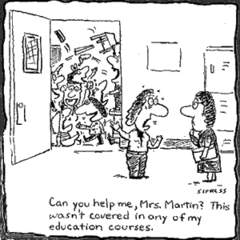 Several decades ago I read an article that I believe was in Time Magazine on the most difficult jobs in America. The article defined a difficult job based on the number of impactful decisions a person had to make in a day. Listed, as one of the most difficult jobs, was that of an eighth grade English teacher. I was surprised to read that, but I was in full agreement, since I was at the time an eighth grade English teacher. A decision is made by considering the information available and making a choice, or taking a course of action. The best decisions can be made when the best and most complete information is available.











 My Island View